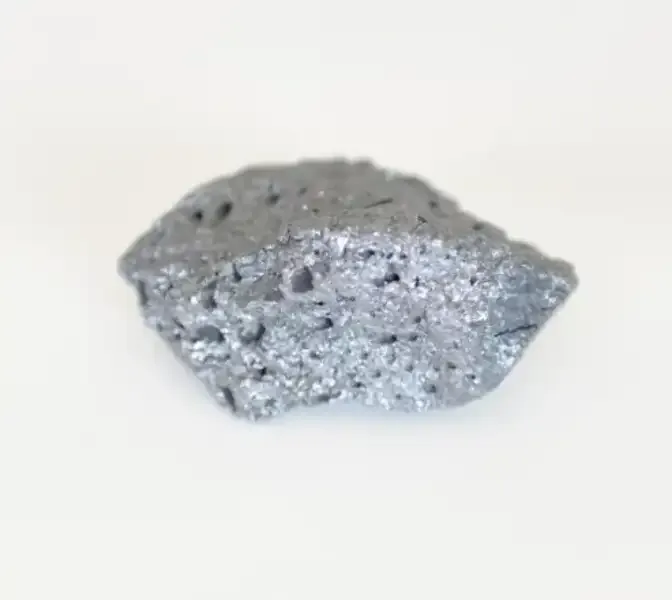
Founded in 1999, Zhengzhou Xiangyu New Materials Co., Ltd., relying on its strong technical capabilities and advanced production processes, has achieved industry-leading quality in boron carbide, becoming a premium supplier for the refractory and abrasive industries.
Borne carbide is produced by high-temperature smelting of boric acid and carbon materials in an electric furnace. It has a theoretical density of 2.52 g/cm², a melting point of 2450℃, and a microhardness of 4950 kgf/mm². Its hardness is second only to diamond and cubic boron nitride, and it features high temperature resistance, acid and alkali corrosion resistance, high strength, good chemical stability, and low specific gravity.
In the refractory industry, boron carbide is widely used as an antioxidant and filler in magnesia-carbon bricks, three main structural components, and castable refractory materials. It not only enhances the thermal shock resistance of refractory materials but also protects them from metal and slag impregnation, preventing the oxidation of carbon in carbonaceous refractories.
The reason it functions this way is that when boron carbide is oxidized, it interacts with the base material to form a liquid or gaseous phase, thus preventing the carbon in carbonaceous refractories from oxidizing and extending the service life of carbonaceous refractories. Besides its use as an antioxidant, boron carbide can also be used as a sintering accelerator for refractory castables. The boron carbide oxidation product, B₂O₃, melts into a liquid phase at lower temperatures, promoting material densification through liquid-phase sintering.
Other Uses
In the manufacture of bulletproof materials, such as bulletproof plates in bulletproof vests, ceramic bulletproof tiles for military aircraft cockpits, and ceramic bulletproof plates for modern armored personnel carriers and tanks.
In the nuclear industry, it is used to manufacture control rods and shut-off bolts for nuclear reactors, boron carbide tiles, plates, or neutron absorbers (made from high B₁₀ content powder) for radiation protection, or mixed with cement to create nuclear reactor shielding layers.
In the manufacture of other engineering ceramic materials, such as nozzles for sandblasting machines, nozzles for high-pressure waterjet cutting machines, sealing rings, and ceramic molds.
Used in welding electrodes to enhance the wear resistance of the weld surface.